

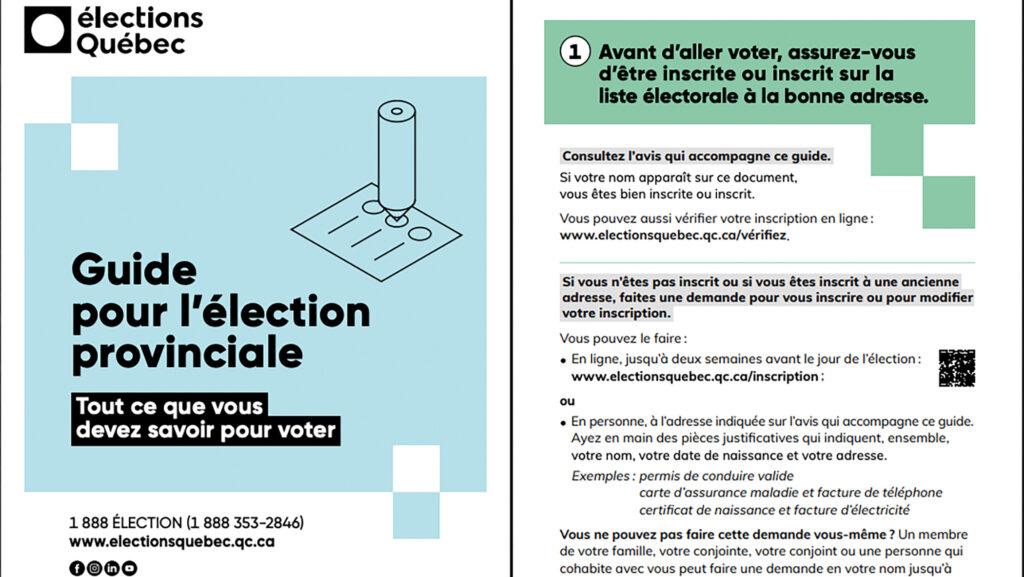

With Élections Québec now saying it is too late to make changes to the unilingual French documents it is mailing to voters ahead of the election, critics are raising concerns about accessibility.
The unilingual documents have prompted an outcry from those who say the French-only documents are creating an unnecessary barrier for voters.
The French documents include a QR code to the Élections Québec website, where information is available in English.
“It’s very cruel, in particularly for elders who have more difficulty using QR codes. So it’s really, really unfair,” said Geneviève Grey, a lawyer at Grey Casgrain.
“Not everybody is tech, not everybody has a computer,” added Eva Ludvig, the director of Talking Advocating Living in Quebec (TALQ). “I think particularly of our senior population and of course, all vulnerable populations.
“We think that this is not equitable treatment for all Quebec and that this breaks the fundamental premise the fundamental principle of democracy.”
CityNews spoke to some Montrealers who were not happy with the voter documents being printed in French only.
“I think it’s important to offer it in English and in French because it’s a bilingual community and so it’s important that everyone has equal access to be able to vote,” said Gabrielle Jay-Riendeau.
“I think the fact that older people have to resort to learning QR codes to get the more detailed information that they want in English is not very democratic,” said another Montrealer. “And I think they could still change those rules if they wanted to.”
“Honestly it would be easier to just have it both in English in French, so it could be easier and accessible for everyone,” added another.
“It’s all new for me,” a 95-year-old woman told CityNews when asked about QR codes. “What do I have in my apartment? TV and my phone, that’s it.”
Élections Québec said Tuesday it could not print the documents in both French and English, as it has done in the past, to comply with language legislation that makes French the sole language of communication for public institutions.
The legislation, adopted in 2022, allows some people to continue receiving services in English. Anglophones who qualify and Indigenous people can contact the agency to request English information, though it says the campaign period is too short to send physical documents.
The agency added that it asked the commissioner of the French language to make an exception for the election, but it was denied.
“It’s not an Élections Québec decision, and we also sought to have an exemption because we think it’s important to provide some basic information at least in both languages in the context of an election,” Élections Québec spokesperson Julie St-Arnaud-Drolet told CityNews.
In an email to the Canadian Press, the commissioner said the law applies to Élections Québec as it is treated as a government organization. It said some exceptions can be made, though “these exceptions do not permit the systematic dissemination of communications in a language other than French.”
The government’s language policy specifies that “institutional bilingualism is incompatible with the Charter (of the French language),” and the commissioner “does not have the authority to create exceptions to the Charter,” it added.
Not everyone expects the change to have a major impact on voting.
Political science professor Donal Gill, from Dawson College, says he understands the concerns but doesn’t expect voter turnout to fall.
“Older people, I think, could be affected, but I believe that political parties will fill that vacuum,” Gill told CityNews. “And so the level of political participation and voter turnout from older Anglophone communities will not be materially affected.”
Party leaders react
Party leaders were also asked to comment on the issue on the campaign trail.
“It is what it is,” said Liberal Party Leader Charles Milliard, acknowledging Élections Québec is an independent agency. Though he shares voter concerns about access to voting, he said there is “not much (he) can do right now.”
Parti Québécois Leader Paul St-Pierre-Plamondon maintained that he opposes institutional bilingualism, but compared voting information to the legal system where Quebecers can access justice in either official language.

“When it comes down to fundamental rights, like voting, there needs to be a mechanism through which anglophones can get information in English,” he said, adding that the Coalition Avenir Québec government’s legislation was “sometimes not planned adequately.”
Québec solidaire’s parliamentary leader, Ruba Ghazal, said she is especially worried for seniors who may not have internet access or understand digital platforms.
“We won’t protect the French language by penalizing citizens,” she said. “They have a right to clear information to participate in democracy.”
Voters should receive information cards by Sept. 18, ahead of the election on Oct. 5, according to Élections Québec.

Add CityNews Montreal as a trusted source on Google to see more local stories from us.
