


Nearly two years after Montreal father Enrico Proietti was diagnosed with stage 3 pancreatic cancer, he and his daughter, Alessia, are turning a devastating diagnosis into a mission to help others.
The call came after a CT scan, and Enrico knew from the doctor’s voice that something was wrong.
He had spent months trying to make sense of persistent pain in his stomach, back and abdomen, along with weakness and unexplained weight loss. There had been no family history of pancreatic cancer to make him suspect the disease.
Then, sitting in the doctor’s office, he saw the scan for himself.
“I got called by the doctor after doing a CT scan the week before,” Enrico said. “He called me into the office and said, I need to see you.”

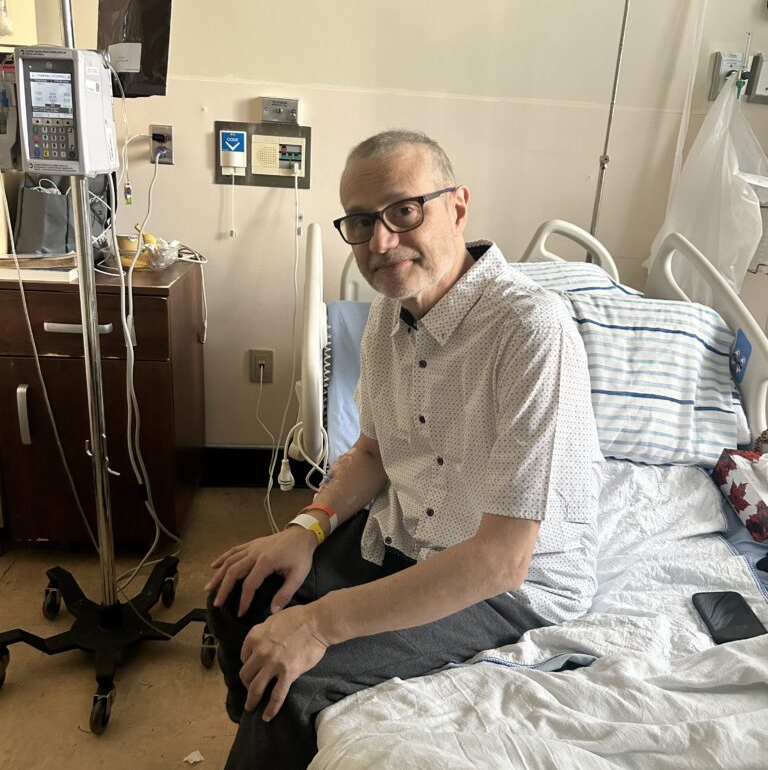
Enrico Proietti is pictured in hospital in this undated handout photo. Proietti is living with stage 3 pancreatic cancer. (Submitted by: Alessia Proietti)
On the computer screen was a tumour near his pancreas.
“It just hit me like a truck,” he said. “I thought at the very moment I just didn’t know what to say. I was at a standstill. I couldn’t believe what was going on to me.”
Nearly two years later, the 62-year-old Montreal father is still living with the consequences of that moment. He has undergone more than 30 rounds of chemotherapy and radiation, and the location of the tumour means he is not eligible for surgery.
But his daughter, Alessia, remembers a different kind of shock — the moment the diagnosis transformed not only her father’s life, but the lives of everyone around him.
‘The world stopped’
Alessia was in her mid-20s when she learned her father had pancreatic cancer. Until then, the disease had existed at a distance, something she knew about through other people’s experiences but never imagined would enter her own family.
There was no family history to prepare them, and the people they had known with the disease had not survived.
“It was very difficult,” Alessia said. “There was no one in our family that had this cancer before, so it was a big shock.”

Enrico Proietti, second from left, poses with his wife, son and daughter in this undated handout photo. (Submitted by: Alessia Proietti)
The news was so overwhelming that she remembers leaving work immediately and crying through the metro ride home.
“I had plans to travel, and I’m in my mid-20s, and instead I just stopped everything and stayed home, and we all did that to try to wrap our head around this disease,” she said.
For the family, there was no easy roadmap for what came next. There were treatments, appointments and difficult decisions, but also the uncertainty of not knowing how long those treatments would work or what would happen when they no longer did.
“You really, it’s like a purgatory state,” Alessia said. “You don’t know what’s next.”
That uncertainty has become one of the defining parts of their experience.
Living in the space between treatments
For Enrico, chemotherapy has meant enduring the physical consequences of treatment while continuing to hope for something that might change the course of his illness.
“My body with chemo, it destroys the bad and the good,” he said, describing weakness, stomach aches, vomiting and neuropathy in his fingers and feet.
For Alessia, watching that happen has meant learning that cancer affects far more than the person whose name appears on the diagnosis.
She has come to understand the complicated emotional calculations caregivers make every day — the feeling that any choice can carry guilt, whether it means staying beside a loved one or taking a moment away to care for yourself.
“You feel guilty for leaving them to do anything for yourself, even go for a walk, because this could be time you’re spending with them,” she said. “But then you feel guilty not going on that walk because you’re not doing yourself a favour. It’s a double-edged sword.”

Alessia Proietti, left, poses with her father, Enrico Proietti, right in this undated handout photo. Enrico is living with stage 3 pancreatic cancer. (Submitted by: Alessia Proietti)
The family eventually found support through Craig’s Cause Pancreatic Cancer Society, an organization Alessia already knew from a life that now feels strangely distant.
Years before her father’s diagnosis, she had been working as a journalist in Alberta when she covered a story about the organization’s Kicking PancreAS 5K. She met its founder and was inspired by the work.
She never imagined she would return to that organization years later for a reason that was so personal.
“It’s a full circle moment for sure,” she said.
After Enrico’s diagnosis, his wife researched support options and found the Society again. Alessia became involved, too, looking for something the family could do at a time when so much felt beyond their control.
“I wanted to raise awareness, raise funds, and do something with my dad to bring some sort of light in this extreme point of darkness,” she said.

Enrico Proietti is pictured during a period of cancer treatment in this undated handout photo. Proietti was diagnosed with stage 3 pancreatic cancer nearly two years ago. (Submitted by: Alessia Proietti)
What began as an attempt to find purpose in a devastating situation also connected the family with people who understood what they were going through.
“Through this organization as well, I’ve been able to meet so many incredible people, survivors, other patients who are going through what we’re going through, and it’s given me renewed hope,” Alessia said.
“And it’s given, I think, our family a sense of empowerment.”

Enrico has found that sense of community through the Society’s national support group, Peers with Pancreatic Cancer.
“We help, support, listen and give each other a pat on the back,” he said.
From the sidelines to the starting line
Last November, the father and daughter brought that sense of purpose to the Kicking PancreAS 5K in Montreal.
They formed Team Purple Purpose and raised $10,000.
For Alessia, the division of labour is straightforward. Her father may not be able to complete the five-kilometre route, but he has become an important voice for the cause.
“I like to say I’m the legs and he’s the mouth,” she said.
She walked the route with friends while Enrico helped spread the word and raise donations.
This year, they are returning to Parc Angrignon on Sept. 19, when the Kicking PancreAS 5K will once again bring patients, families and supporters together for a walk and run dedicated to pancreatic cancer.

The event is open to people of different ages and abilities, with participants able to walk or run the five kilometres.
For Alessia, the value of the event extends beyond the money raised. She wants pancreatic cancer to become a disease people know about before they are forced to learn about it through someone they love.
“These events raise awareness about this cancer, so you don’t just hear about it when you’re impacted — you care about it before,” she said.

In Quebec, 1,800 new pancreatic cancer cases and 1,600 deaths are expected in 2026, according to information provided by Craig’s Cause. The organization has spent 20 years working to improve outcomes for Canadian pancreatic cancer patients through awareness, research, education and patient support.
For Enrico, the need for better outcomes is not abstract.
He remembers the months when his symptoms could have pointed to any number of conditions, and he wants other patients and doctors to have pancreatic cancer on the list of possibilities sooner.
“The signs are very difficult to pick up and most doctors think it could be a stomach problem, celiac, any disease except pancreatic cancer,” he said.
He hopes research can help change that.
“What I want from this participating in this race is that we can spend money into research for this disease and have people try to catch it earlier,” Enrico said.
‘There is hope’
For all the uncertainty that has followed the diagnosis, Alessia does not want the disease to become the only story people see when they look at her family.
She has watched her father endure treatment, experienced the fear that came with learning his diagnosis and discovered the emotional weight that comes with caring for someone she loves.
But she has also found a community, a cause and a way to turn helplessness into action.

When she thinks about the people who will take part in the race, that is the message she wants to leave with them.
“I want to give them hope,” she said.
“For the longest time, I was just really in the dark. It was really difficult grasping this diagnosis and thinking that your time is shortened.”
She does not want patients or families to believe that a diagnosis means they have to surrender every part of their lives to the disease.
“I don’t want people to be consumed by this disease. I want people to know that they’re not alone, and that they can get through this, and that they can find moments of joy in times of pure darkness.”

Add CityNews Montreal as a trusted source on Google to see more local stories from us.
