


Quebec is gradually introducing self-collection for cervical cancer screening, offering an alternative to traditional pelvic exams for people who may have delayed testing or face barriers to accessing health care.
The initiative is currently being rolled out in Chaudière-Appalaches. Dr. Jeannot Dumaresq, a medical microbiologist and infectious diseases specialist with Santé Québec in the region, says the Health Ministry and Santé Québec have asked hospitals and regions across the province to make self-sampling available next year.
The tests detect human papillomavirus (HPV), a virus that can cause cervical cancer, and allow eligible individuals to collect their own samples without requiring a health-care professional to perform the initial pelvic exam.

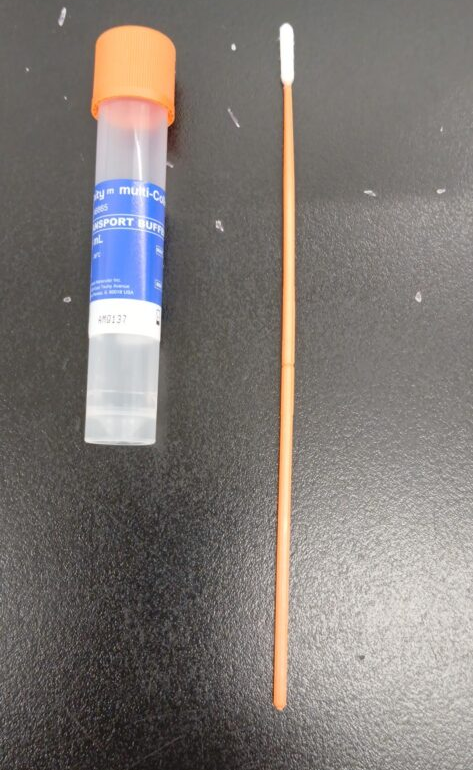
A swab and collection tube used by patients to collect their own samples for human papillomavirus (HPV) testing as part of cervical cancer screening. (Courtesy: Santé Québec Chaudière-Appalaches)
Dr. Shannon Salvador, a gynecologic oncologist at the Jewish General Hospital and an associate professor at McGill University, says the initiative could help reach people who have difficulty accessing screening.
“This is an incredible progression for Quebec and being able to treat and screen people who could potentially have cervix cancer or pre cancer of the cervix,” Salvador said.
Removing barriers to screening
Dumaresq says the self-collection option is intended to reach people who may be uncomfortable with traditional screening or have put it off for years.
“A lot of people are reluctant to have a pelvic exam for the cervical cancer screening either because of anxiety, because of discomfort, past trauma or sometimes cultural norms,” he said.
He estimates that roughly one in four women is not up to date with cervical cancer screening.
Dumaresq says cervical cancer is one of the most preventable cancers, thanks to vaccination and screening. He says early detection is associated with very high survival rates, while the chances of survival drop sharply when the disease is diagnosed at a later stage.
Salvador says the test could make screening more accessible to people who struggle to reach health-care providers.
“The individuals who can benefit the most from this test are those who do not have easy access to the healthcare system, whether they don’t have a family doctor or they’re too far remote and they can’t come into an area where there is healthcare professionals who do this test,” she said.
How self-collection works
The process involves a swab and a transport tube. Eligible individuals can collect their own sample at a clinic or take the kit home before returning it to a health-care provider.
Dumaresq explains how the sample is collected.
“We give the person a kit. There’s a swab, there’s a transport tube and then the person has to insert the swab just a few centimeters inside the vagina, just turns it there for a couple of seconds, then we put it back in the transport tube and that’s it. And then we bring it back to the medical clinic, the local service point or the test center,” he said.
The service is covered by the Régie de l’assurance maladie du Québec (RAMQ).
For now, there are no plans to distribute the kits by mail. Dumaresq says they are available through medical clinics known as local service points. People with a prescription can also obtain a kit at traditional testing centres, complete the sample at home or on-site and return it to their health-care provider.
Positive results require further testing
A positive HPV result does not mean someone has cervical cancer, but further investigation is necessary.
Dumaresq says anyone who tests positive will need further screening to determine whether cancerous or precancerous changes are present.
“We have to make sure that the person knows that if the result is negative, that we will just do another screening in a couple of years. But if the test is positive, the person has to know that then a pelvic exam will be needed to collect some cells directly in the cervix to look at the cells and see if there is cancerous or pre-cancerous cells,” he said.
Salvador says people with positive results should be followed in a specialized clinic, such as a colposcopy clinic, where they can be assessed by a gynecologist or gynecologic oncologist.
She says laboratory validation has also helped address concerns about the reliability of samples collected by patients themselves.
“They have now shown that with the new validations that they do in the lab, they’re able to identify that the sample is just as good as a sample collected within a clinic by a healthcare professional,” Salvador said.
If a sample does not meet laboratory validation requirements, Salvador says the person will be notified and may be asked to repeat the test or have a health-care professional collect the sample.
Provincewide rollout expected next year
Although Santé Québec and the Health Ministry have asked regions to offer self-sampling next year, implementation will be gradual because laboratories use different HPV tests, and each must be validated to ensure it works with self-collected samples.
Dumaresq says the validation process is necessary because the tests used in Quebec laboratories vary.
“In Canada there is no HPV or human papuomavirus test that is approved by Health Canada for self-sampling. So every lab had to do what we call a validation to make sure that the kits, the sampling kits we use, the tests we use in the lab are compatible and it works well with self-sampling,” he said.
Dumaresq says regions using the same laboratory test as Chaudière-Appalaches can use the results of its validation work, while regions using different tests must complete their own validation.
In a statement to CityNews, Santé Québec said it began working with health and social services institutions following a September 2026 update to HPV self-sampling guidelines and standards by the Institut national d’excellence en santé et en services sociaux (INESSS).

“The next steps will be determined once this work with the network is completed,” the statement said. “Each region will be able to organize implementation based on its local context and available resources.”
Santé Québec also confirmed that its Chaudière-Appalaches institution is currently the only one gradually rolling out self-sampling for cervical cancer screening.
Salvador hopes the program will be available across Quebec by early to mid-2027, although a provincewide implementation date has not been confirmed.
She stresses that timely follow-up is essential for anyone who receives a positive result.
“If you know that you are positive, is it extremely important that you get in for the next steps, which is a colposcopy. To miss that is the shame of why did we even do the test in the first place,” she said.
In the longer term, Dumaresq hopes self-collection will help detect more precancerous changes before they develop into cancer, potentially preventing cases and deaths.

Add CityNews Montreal as a trusted source on Google to see more local stories from us.
