

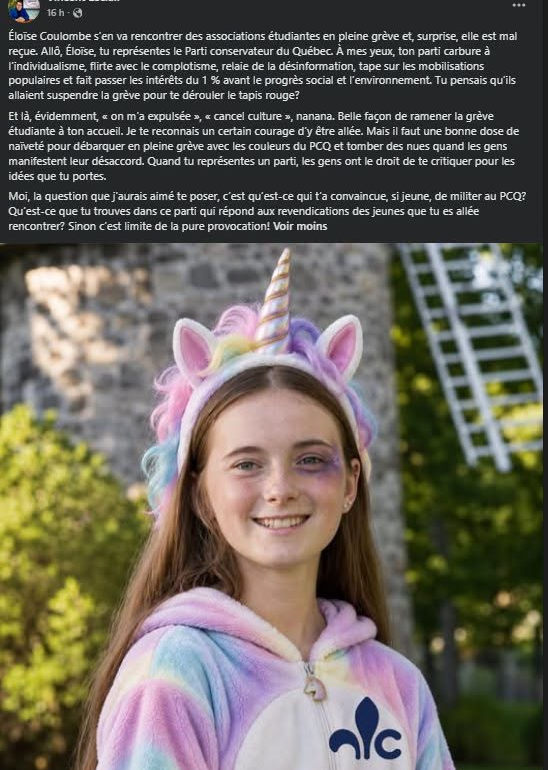

The president of the Montreal FTQ Regional Council, Vincent Leclair, submitted his resignation on Monday, a few days after sharing an AI-generated image in which Conservative MNA Éloïse Coulombe appeared with a black eye.
Although the image has since been deleted, it continues to circulate online.
The post drew criticism from Conservative Party of Quebec Leader Éric Duhaime, who addressed the controversy during a news conference Monday at the National Assembly, saying this type of content has “no place in public discourse”.
“In a climate where violence against women — particularly online — remains a major concern, we all have a responsibility to exercise vigilance and show respect in our words and our posts,” said Duhaime.
Technology analyst Carmi Levy says the circumstances surrounding the post are particularly concerning, given Leclair’s connection to one of the province’s largest labour unions.
“We normally associate the creation of deepfakes with hacking groups, shadowy in organizations or individuals,” said Levy. “But in this case, it’s an individual attached to one of the most powerful labour unions in the province.”
Leclair had been criticizing Coulombe, who became the youngest MNA in Quebec history last month, over her attempt to meet with striking students at Université Laval last week.

Vincent Leclair’s post featuring an AI-generated photo of MNA Éloïse Coulombe with a black eye. (Screengrab)
Political commentator Anne Lagacé Dowson says the image and the way Leclair chose to criticize Coulombe overshadowed any message he may have been trying to convey.
“I think the idea that Leclerc had was that she needed to be doing more to show understanding and sympathy with the students, but he did it in such a terribly inept and sexist way that any message he was trying to get out is completely lost and completely discredited,” said Lagacé Dowson.
Lagacé Dowson says the incident also points to the persistence of misogyny, particularly on social media, where hostility toward women can be expressed and amplified.
“There is a real problem with misogyny in the society that we live in,” she said. “A lot of it has been highlighted and discussed, but not nearly enough progress has been made. And it sort of lies hidden in the hearts of many people, many guys who are angry about all kinds of things. And it gets vented against women in this way by means of social media, which allows you to say and do things that you would never do normally in civil society or you would never do these things if you were in contact with actual real people.”
Valérie Lapointe, a UQAM PhD candidate specializing in human-AI relationships, says depicting women as physically harmed can contribute to the normalization of violence against them.
“Then it amplifies the problems when you start using artificial intelligence, because now you can create content, any type of content based on anyone you want with very little safeguards in place, very little barriers to access,” said Lapointe. “Depicting a woman in a vulnerable state, who has been physically hurt, that I think in a way resonates with the current violence against women that we’re seeing, like the increase in the normalization of harm against women.”
Following the backlash, the FTQ announced Monday that it had accepted Leclair’s resignation. The organization also published the letter in which he apologized for posting the image and acknowledged that it trivialized violence against women.
“For decades, the FTQ has been fighting violence against women, including violence targeting women involved in politics,” Leclair wrote. “This fight is more important than my position, and I refuse to let my actions harm the people who are leading it.”

Vincent Leclair, president of the Montreal FTQ Regional Council’s resignation letter. (Courtesy: FTQ Montreal Metropolitan Regional Council)
FTQ president Magali Picard also addressed the controversy on social media, saying she had spoken with Coulombe to apologize on behalf of the organization. Picard added that the post targeting the MNA was completely unacceptable.
Coulombe later took to social media to say she appreciated Picard’s apology.
‘Should be treated as criminal behaviour’
But Levy says Leclair’s resignation does not undo the harm caused by the image, which continues to circulate despite its removal from the original account.
“The individual in question has submitted his resignation, but the problem persists,” said Levy. “The imagery is still out there. It has been copied and shared and reshared multiple times. And so you’re not putting it back in Pandora’s box. The victim continues to be victimized.
“This can and should be treated as criminal behaviour. And even though at the current time, there are no specific laws on the books dealing with deepfakes, there are a number of bills working their way through the House of Commons now that would make actions like this criminal. And in all honesty, that’s the lens through which we should be looking at this.”
The incident also highlights concerns about how easily AI-generated images can be created and the potential consequences when the technology is misused.
Lagacé Dowson says the controversy should serve as a warning about the harm that can result from the technology.

“We know the technology is very powerful and we know that terrible mistakes and terrible attacks can be made with it,” said Lagacé Dowson. “So we all need to be warned and caution. This is like a cautionary tale, the story of this guy at the FTQ.”
Levy says organizations, including labour unions, government agencies and businesses need to ensure their employees understand the risks and responsibilities associated with using AI.
“Your people need to be properly trained on the dos and don’ts of AI and deepfakes,” said Levy.
—With files from The Canadian Press

Add CityNews Montreal as a trusted source on Google to see more local stories from us.
