


Democrats have picked up three key U.S. Senate seats in one of the most consequential midterm elections in decades
The GOP held a 53-47 majority ahead of the midterms and thirty-five seats are up for reelection: Republicans hold 22, while Democrats hold 13. With Republican Vice President JD Vance’s ability to break tie votes, Democrats need 51 seats to win control of the chamber.
So far, the Democrats have flipped two key Senate seats in North Carolina and South Carolina and have won again in Georgia and New Hampshire.
They currently hold 48 seats.
CityNews 24/7 has live coverage of the midterm elections. You can watch it on the CityNews website.
Here are the nine key Senate races to watch:
Story will be updated as results come in
Senate races
Alaska
(Currently held by a Republican)
Rep. Mary Peltola’s decision to run for Senate was a huge win for Minority Leader Chuck Schumer and Democrats as she takes on GOP Sen. Dan Sullivan, a lowkey conservative who does not stray often from the party line.
Peltola, who won a U.S. House special election to replace the late Rep. Don Young in 2022, later won a full term, defeating former vice presidential candidate Sarah Palin. A former tribal judge, Peltola was the first Alaska Native to represent the state in Congress, and she would be the same if elected to the U.S. Senate. She lost reelection in 2024 to GOP Rep. Nick Begich.
Polls have suggested this is a very close race. Peltola has attempted to position herself as an independent voice and distanced herself from national Democratic political figures.
Alaska elections use ranked choice voting, so if neither Sullivan nor Peltola receives over 50% of the vote, it could be a while until a winner is determined. To further complicate matters, there is another candidate named Dan Sullivan — not the incumbent senator — on the ballot.
Georgia
Democrat Jon Ossoff won election Tuesday to the U.S. Senate representing Georgia, defeating Republican Mike Collins.
Ossoff was the only Senate Democrat seeking reelection in a state that President Donald Trump won in 2024, and holding his seat was critical to his party’s hopes of flipping control of the Senate. Ossoff was considered vulnerable at the outset of the 2026 election cycle.
But he vastly outraised Collins, a two-term congressman who won Trump’s endorsement during an extended Republican primary, and he ran an aggressive campaign that gained national attention for his biting critiques of Trump.
Iowa
(Currently held by a Republican)
Sen. Joni Ernst is retiring, opening up one of Iowa’s slots in the Senate for the first time since she flipped the seat for Republicans in 2014. The race presents an opportunity for Democrats, who hope Obama’s presidential wins in Iowa are more than a distant memory.
The Democratic nominee is state Rep. Josh Turek, who has served two terms in a competitive state House district and has two Paralympic gold medals. Amid a difficult political environment for Republicans and the effects of Trump tariffs and rising gas prices on Iowans, the party is counting on Turek to spark Democratic turnout and win over some of Iowa’s 572,000 nonpartisan registered voters.
Turek faces a tough campaign in a state that Trump carried in the last three presidential elections and where Republicans have held a political trifecta since 2017. The GOP nominee, U.S. Rep. Ashley Hinson, touts a Trump endorsement, though she may be feeling the political pressure of being tied to the president’s agenda. On Sept. 21, about a week after voting not to end the war in Iran, she wrote on X that “Iowans are being squeezed and shouldn’t have to foot the bill at the pump or the checkout line for the war in Iran.” She went on to say that “the war needs to be brought to a successful and immediate end.” The next week, she appeared in the Oval Office as Trump announced a new $15 billion steel plant in her battleground state.
Ohio
(Currently held by a Republican)
Former Democratic Sen. Sherrod Brown is back on the campaign trail after losing his seat to Republican Sen. Bernie Moreno two years ago. This November, Brown is running for Ohio’s other Senate seat, challenging Republican Sen. Jon Husted, who was appointed in 2025 to the seat vacated by Vice President JD Vance.
Data centers are a fulcrum for both campaigns. Brown has frequently referred to his opponent as the “face of data centers” in Ohio. Husted has been trying to separate himself from that image. One of his clearest counters to that label, a bill related to energy costs of data centers, failed to pass the Senate last week.
Brown’s hopes of returning to Washington hinge on whether his familiar name and past record will still resonate in a reddening state. Ohio hasn’t elected a Democrat to statewide executive office since 2008 and Trump has carried the state in the last three presidential elections. Despite his state’s shift towards Republicans in the past decade, Brown has continuously outperformed Democratic presidential candidates in Ohio since first winning his old Senate seat in 2006. Democrats are hoping he’ll do it again.
Maine
(Currently held by a Republican)
Sen. Susan Collins is the lone Republican representing a state that has never voted for Trump. Like in her last election six years ago, she is the top target for Democrats. Ousting her, however, is proving to be anything but straightforward.
Democrats initially nominated Graham Platner, an oyster farmer who ran an energetic grassroots campaign that forced Gov. Janet Mills, Senate Democrats’ preferred pick, to suspend her campaign before ballots were cast. However, he withdrew his candidacy after he was accused of sexual assault.
In an emergency nominating convention, Maine Democrats picked Troy Jackson, the former state Senate president who finished third in the first round of the governor primary. Polling has shown that he and Collins are in a neck-and-neck race.
Jackson, who was endorsed by progressive stalwart Sen. Bernie Sanders in the governor primary, has a similar political bent to Platner, but has not campaigned as vigorously as the man he replaced on the ballot.
Collins has campaigned on local issues, highlighting her seniority in the Senate and the federal investments she’s brought to the state. Jackson, on the other hand, has attempted to nationalize the race, hoping the political environment will finally bring an end to a political institution in Maine.
Michigan
(Currently held by a Democrat)
Democrats haven’t lost a U.S. Senate race in Michigan since 1994, and they’ll need to lean on that track record again in the Wolverine State.
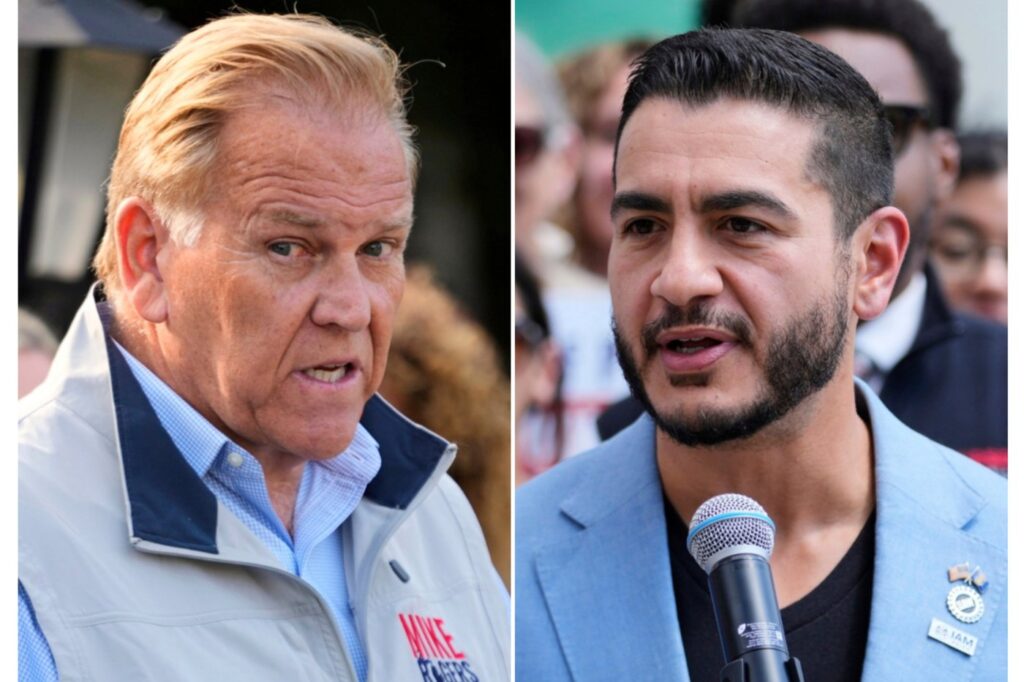
The party’s hopes lie in Abdul El-Sayed’s hands. El-Sayed, a progressive and former public health director of Wayne County, narrowly defeated Rep. Haley Stevens in the Democratic primary despite a heavy spending advantage in Stevens’ favor. Stevens had the backing of the Michigan Democratic political establishment, including the outgoing Sen. Gary Peters and Gov. Gretchen Whitmer, but El-Sayed effectively tapped into the energy on the left flank of the Democratic party that saw progressives notch wins in primaries across the country. If elected, El-Sayed would be the nation’s first Muslim senator.
In the general election, he’ll face former Rep. Mike Rogers, who narrowly lost the 2024 U.S. Senate race to Democratic Sen. Elissa Slotkin. While Trump won Michigan, he couldn’t carry Rogers over the line — Rogers received roughly 123,000 votes fewer than Trump, and Slotkin won by about 19,000 votes. Now, Rogers will have to contend with a political environment that favors Democrats, and with no Trump on the ballot.
Rogers, who served seven terms in the House from 2001-2015, has attacked El-Sayed’s progressive stances and his Muslim faith, as well as his ties to far-left streamer Hasan Piker. El-Sayed, in turn, has attacked Rogers’ obedience to Trump and has tried to stay focused on cost-of-living issues.

Stevens endorsed Rogers with just less than 48 hours to go before election day, but was quickly rebuked by Michigan and national Democrats after the remarkable show of support for the candidate backed by President Donald Trump.
New Hampshire
Democrat Chris Pappas won election Tuesday to the U.S. Senate representing New Hampshire, defeating Republican John Sununu.
The race was one of a handful that will help determine which party controls the Senate and Pappas’ victory defended the key seat for the Democrats. Pappas, a member of the U.S. House, will replace Democratic Sen. Jeanne Shaheen, who decided not to seek reelection. Sununu previously served in the Senate and House.
Pappas is also the first openly gay man elected to the U.S. Senate.
North Carolina
Democrat Roy Cooper won election Tuesday to the U.S. Senate representing North Carolina, defeating Republican Michael Whatley. Cooper’s victory gives Democrats a key pickup in their quest to wrest Senate control from Republicans.
The seat was open because Republican Sen. Thom Tillis opted not to seek another term. Cooper is a former governor and state attorney general. Whatley is a former state and national Republican Party chairman who ran with President Donald Trump’s support.
Texas
Democrat James Talarico won election Tuesday to the U.S. Senate representing Texas, defeating Republican Ken Paxton.
Talarico’s victory represents the first time a Democrat has won a statewide office in Texas since 1994, a shakeup for a state long dominated by Republicans. The outcome boosts Democrats as they look to retake control of the Senate.
A seminary student and state representative, Talarico focused on bringing down everyday costs and revisiting corruption allegations against Paxton, a state attorney general. Paxton, who had President Donald Trump’s endorsement, said Talarico’s progressive stances on social issues were out of step with Texas.

Add CityNews Montreal as a trusted source on Google to see more local stories from us.
