

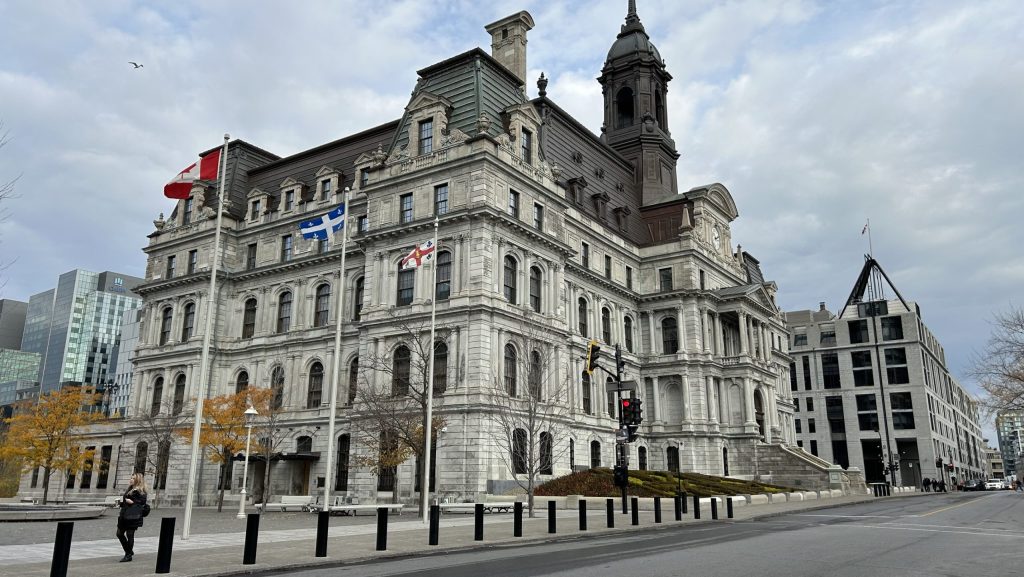

Two legal groups have filed a lawsuit at Quebec Superior Court seeking to suspend a recent Montreal bylaw banning insults against police officers and other municipal employees.
Lawyers belonging to Association des juristes progressistes (AJP) and Clinique juridique de Saint-Michel (CJSM) say the bylaw infringes rights enshrined in the Canadian and Quebec charters.
“We believe that this bylaw infringes on freedom of expression and risks creating more tension and repression, especially in a context where the government is increasingly targeting its critics,” said Béatrice Allard, a board member of the AJP.
The lawyers also said the bylaw could be used by police officers and other the city employees to discriminate citizens based on their political beliefs.
“We are concerned that it could be used against people speaking out about racial profiling or police conduct, including during protests,” said Fernando Belton, executive director of CJSM. “So we think that police should not have the power to decide which criticism of them is acceptable.
“We think that being offended by someone’s word should not be enough to justify a fine because it’s protected under freedom of expression.
“It could limit freedom of expression in a way that it’s not permitted under the Charter.”
Legal expert Julius Grey says the bylaw offering a special protections for police officers and other city employees are “not reasonable.”
“I think a citizen has a right to tell a policeman, ‘I can’t stand you, you’re doing the wrong thing,’” Grey said. “A citizen doesn’t have to be elegant, well educated, very careful with his words. He might emote, he might use big words. And saying that you can’t insult a police officer or another city official is basically restricting the citizen’s right to complain to the person.”
Bylaw rules
The Montreal City Council adopted the bylaw called Règlement interdisant les comportements inappropriés à l’égard des membres du personnel de la Ville de Montréal, in French, last month. Other municipalities in the province, including Quebec City, Laval, Longueuil, and Sherbrooke, also have similar ordinances.
Under the Montreal bylaw, citizens who insult or threaten municipal workers could face fines ranging from $300 to $1,000 for a first offence. Subsequent offences could result in fines of up to $2,000.
“This bylaw has important objectives, but may have very serious negative consequences on people,” said Fo Niemi, the executive director of the Center for Research-Action on Race Relations (CRARR). “It requires more study. It may require, we don’t even know how people will be trained when they apply this bylaw. And more important, what kind of safeguards there are to protect constitutional rights and freedoms.”
Several civil rights groups and opposition councillors had criticized the legislation as being vague allowing room for interpretation or misuse by officials.
“The courts have recognized that granting overly broad powers, such as random traffic stops and police stops, leads to abuse and racial profiling,” Belton said.
“This bylaw follows the same pattern. At a time when trust in the police is shaken, the City should seek to rebuild that trust rather than give even more powers to law enforcement, when all indications suggest that this will lead to abuses and overreach, particularly against people of colour and marginalized communities,” he added.
During the city council debate Montreal Mayor Soraya Martinez Ferrada defended the bylaw calling it necessary to protect the municipal staff, including several women employees who were often targets of inappropriate behaviour.
However, she acknowledged that other questions about the ordinance would arise in the coming months but insisted that the administration needed to take action. She stated that the administration would make the reports available to the public.
“We think protecting city employees is essential, but it must be done in a way that respect people’s rights,” Belton said.
“Law already exists to address threat and violence intimidation so we can protect employees, including police officers, without giving such broad powers to punish people for the words.
“There’s limits that exist to freedom of expression. Those limits are inside of the criminal code. And that’s one of the argument that we’re making also is that law already exists to address threat and violence, intimidation. So we can protect employees, including police officers, without giving other really such broad powers to punish people for the words.”
In a written response to CityNews, the City of Montreal declined to comment on the legal challenge of the bylaw.
The debate over banning insults in Montreal resurfaced after videos showing a man insulting a police officer with misogynistic remarks went viral. The man was charged in July with defamation under the criminal code and pleaded not guilty.

What do residents have to say?
“For that, I’d say it would be a violation against the concept of the right for people of freedom of speech,” West Island resident Benjamin Desmarais told CityNews.
“If the balance of power is completely unequal, people must certainly be free to speak out about the police’s conduct,” said Cheikh Fall of Brossard.
“I think we’re in Canada, right?” said Jon from Montreal. “It’s a free country. So free country equals freedom of speech, equals we get to say whatever we want to the public.”
— With files from The Canadian Press

Add CityNews Montreal as a trusted source on Google to see more local stories from us.
