


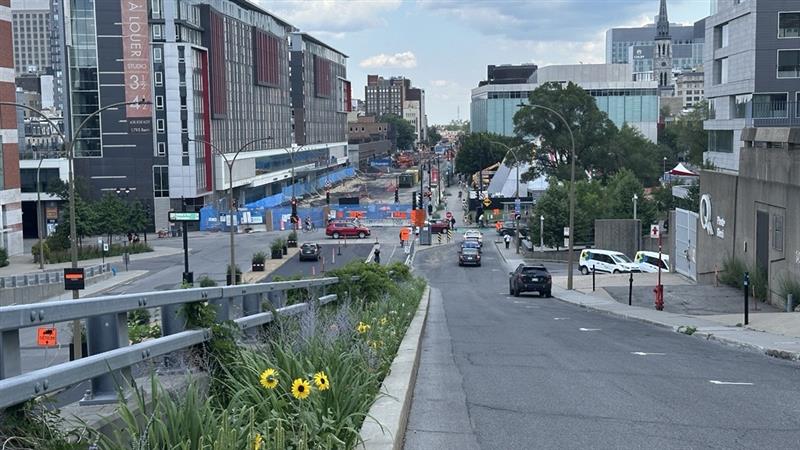
Montreal is revisiting the design of the future Berri Street bike path before construction is complete, saying the original plan no longer reflects the city’s vision for one of the busiest corridors into the Quartier latin.
The review comes as major infrastructure work continues along Berri Street around Berri-UQAM station, where construction has already disrupted traffic for motorists, cyclists and pedestrians.
In a written statement, the mayor’s office said the review extends beyond safety concerns and includes looking at options that meet Montreal’s Express Bike Network standards while avoiding placing the bike path directly in front of the bus terminal entrance.
“As part of this review, we’ve also asked our teams to look at options that meet Montreal’s Express Bike Network standards while avoiding having the bike path run directly in front of the bus terminal entrance. The goal is to avoid having to rely on a long list of mitigation measures, like excessive signage and other safety features, to reduce the risk of collisions,” the statement said.
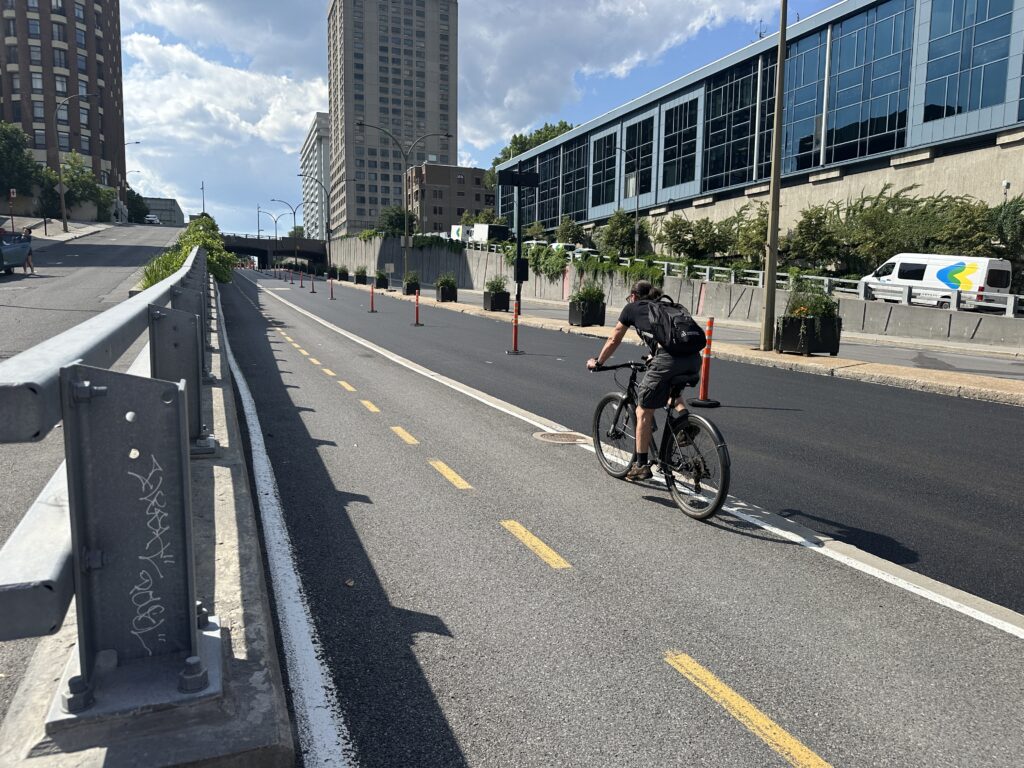
The proposed changes are raising concerns among cycling advocates.
Jean-François Rheault, chief executive officer of Vélo Québec, said the organization supports creating a more attractive streetscape, but not at the expense of safety.
“When the administration expressed the desire to make something magnificent and something beautiful, that’s great news. We just wanna make sure that cyclist safety is not put aside as a second level priority,” said Rheault.
Rheault said the previous administration’s plan for one-way bike paths would have provided better protection at intersections than a two-way path on one side of the street.
“The previous administration has chosen unidirectional bike path that are much easier to secure at intersections. Coming back to a bidirectional bike path two ways on the same side of the street makes it much more complicated to secure,” said Rheault.
The official opposition says the existing plan was designed to improve safety along one of Montreal’s busiest cycling routes.
Christopher McCray, Ville-Marie borough councillor for Projet Montréal, said the corridor is used by about 10,000 cyclists each day.
“Intersections are dangerous, hundreds of collisions, cyclists and pedestrians, sometimes severely injured, and a cyclist was killed in 2021 at the corner of Berri and Ontario,” McCray said.
Some residents say construction has already made the area difficult to navigate.
“It’s so confusing right now because there’s so much work going on. And this is one of the most dangerous intersections in the city in terms of cyclists, cars, pedestrians,” said Alain Hébert, a resident.
“It’s a major scar in our neighbourhood. It really splits the neighborhood into its four lanes that shouldn’t be here. And so if we’re going to spend millions of dollars, let’s do something different,” Hébert said.
Business leaders support the ongoing reconstruction but say the redesign presents an opportunity to improve the corridor.
Julien Vaillancourt-Laliberté, executive director of the Société de développement du Quartier latin, said the work has long been needed.
“We always considered that the Plante administration had a good idea in terms of doing the work itself because it was needed for a long time. Infrastructure wise, aesthetically wise, it was needed. Was it the best plan in itself? I do not think,” Vaillancourt-Laliberté said.

While he was initially concerned the review could delay construction, Vaillancourt-Laliberté said the city has assured stakeholders the infrastructure work will stay on schedule.
“So all the infrastructure work will be done by December 2028. This is one of the guarantees we’re given,” Vaillancourt-Laliberté said.
Add CityNews Montreal as a trusted source on Google to see more local stories from us.
