

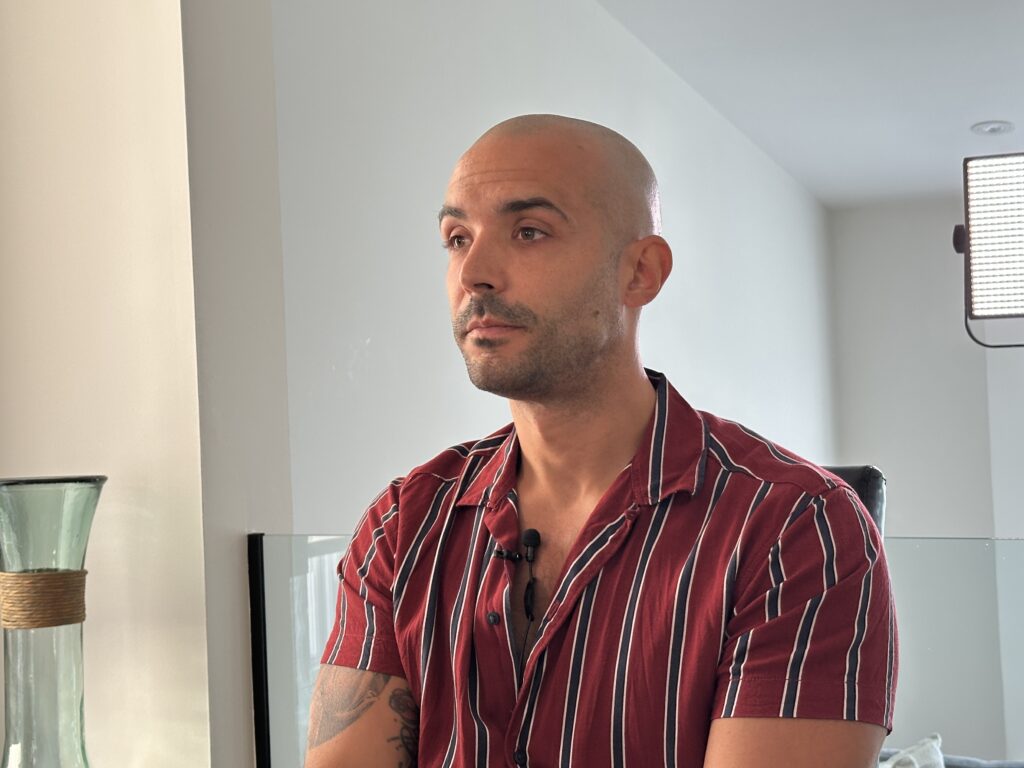

Twenty years after surviving the Dawson College shooting, James Santos can still remember the moment everything changed.
Now a Montreal police officer, Santos says the events of Sept. 13, 2006, not only left him with lasting trauma, but also inspired the career he chose. Watching police officers respond to the attack that day showed him the kind of person he wanted to become.
“It just takes one individual that’s in a need of help and does something traumatic or cry and it lasts — a ripple effect that just continues on,” said Santos.
Santos had just begun his first semester at Dawson College when he met Anastasia De Sousa earlier that summer while on vacation. On the morning of Sept. 13, De Sousa wrote to him.
“She messaged me saying, ‘oh, you want to do something?’”
The pair decided to have lunch inside the college cafeteria. Santos says it was crowded, with only one table available.
“I was like, ‘oh, let’s stay inside. I have my own lunch,’ and stuff like that. So she said, ‘fine.’ We found that the cafeteria was full. It was pretty much like the rush hour. And we found only one spot, one table near the entrance of the main building.”
Santos says De Sousa was sitting with her back facing the main entrance. Moments later, a gunman walked into the cafeteria.
“Out of nowhere, I see the shooter come in. At this point, I had no idea of anything,” said Santos.

At first, Santos believed the weapon was fake.
“But then when he pretty much put the weapon onto the ground, which the sound, the distinctive sound of metal and tile, I’m like, ‘oh, that’s not plastic or anything like that.’ So I sort of jumped or dove behind to take cover.
“He was reaching under his jacket to get a gun at that time. I didn’t know what it was, but it was a 9mm and he took it out.”
Santos says he didn’t immediately realize De Sousa had been shot.
“The first shot hit her, I didn’t know at that time. And then he just continued shooting at the cafeteria. I just saw her collapse. I thought she fainted.”
He crawled back to her and tried to help.
“She was on the floor and I didn’t want to stay there,” said Santos. “I put her in the recovery position. She started obviously trembling and stuff like that. So I didn’t know what was going on. I was very young. I just saw her bleeding and I knew that she really got shot by a real gun. So I tried to just console her. I spoke to her. I tried to tell her like, ‘listen, everything’s going to be okay. I’m here.’”
As police surrounded the building, Santos says the gunman turned his attention toward him.
“He kept looking at me, kept looking at me. And then eventually he stopped. He pointed his weapon at me. He’s like, ‘OK, you get up. OK, don’t move, turn around. I want your back facing me.”
Believing he might be killed, Santos says one thought stayed with him. “So I thought, OK, maybe he’s going to execute me in front of the police officers. And at that point, I just remember thinking to myself, well, if that’s the case, I’m OK with it. I just don’t want it to hurt like how I saw her.”
He says he tried repeatedly to persuade the gunman to surrender.

“We spoke a handful of times. And a couple of times I tried to convince him, I tried to tell him, ‘listen, there’s other ways to go about it that you could stop.’”
Instead, Santos says the gunman told him he expected to die. “That’s what he told me.”
The gunman then asked about De Sousa.
“He looked at Anastasia, then looked at me. And then he asked me how she was doing.”
Santos says he told him he didn’t know because he was being held at gunpoint.
“He didn’t say anything. He loaded his semi-automatic, he walked over there. I remember at this point, it was that side of it. He walked next to her point blank, he unloaded his whole gun on her and he came back to the same position. And then he looked at me and he’s like, ‘well, now you have nothing to worry about.’”
Even then, Santos says he convinced himself she might survive.

“I made myself believe that he missed everything, that she was going to be OK,” said Santos.
Moments later, police shot and killed the gunman, ending the attack. Santos says he fled the cafeteria before being stopped by officers outside.
In the months that followed, he says he struggled with survivor’s guilt and the belief that he had somehow failed De Sousa. Today, Santos says he prefers to remember his friend for the joy she brought to those around her.
“And her laugh was hilarious as well too,” said Santos. “Anybody that knows her, her laugh was very, it would capture the room. You would laugh automatically with her. So that’s my fondest memory that I have with her.”
Now working for the SPVM, Santos says he hopes his own experience can help others dealing with trauma.

Add CityNews Montreal as a trusted source on Google to see more local stories from us.
