

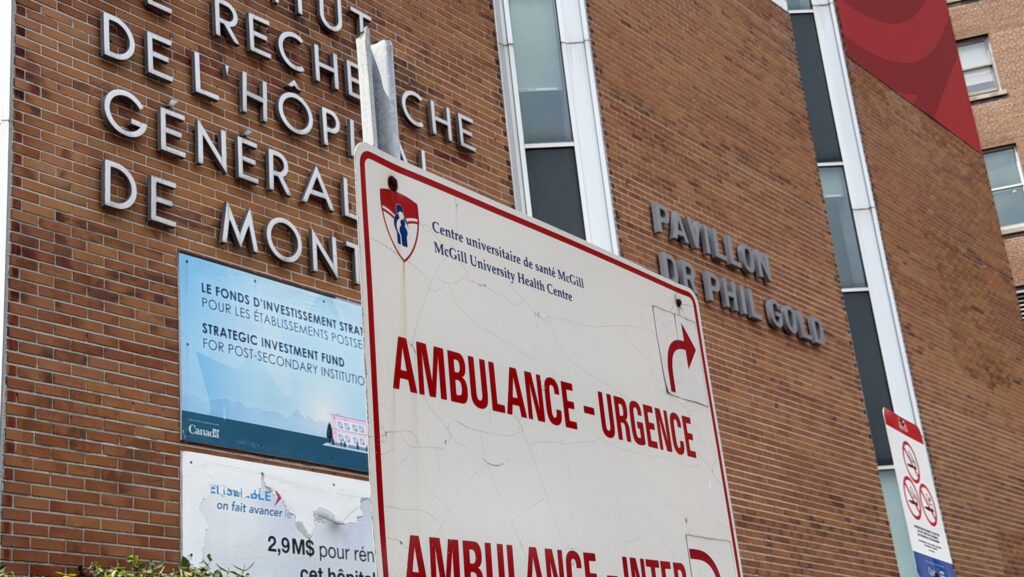

Emergency rooms across the Greater Montreal region continue to be overcrowded, with wait times averaging nearly five-and-a-half hours.
In Montreal, ER patients on stretchers had an estimated wait time of more than 17 hours on average Monday. Some 260 patients were left waiting for more than 24 hours, and 129 patients spent more than 48 hours waiting, according to Index santé.
“An emergency ward should not be a place where you wait for 20 hours,” said Paul Brunet, the Chair of the Montreal Council for the Protection of Patients. “You should be able to see a health professional elsewhere because you’re not in life-threatening danger, but unfortunately if you don’t have these alternatives, what do you do?”
As of early afternoon., three hospitals in the city had an occupancy rate of more than double their capacity: the Jewish General at 226 per cent, the Royal Vic at 221 per cent, followed by the Lakeshore Hospital on the West Island at 216 per cent.
Other major hospitals in the city were also over-extended with occupancy rates at the Montreal General at 158 per cent, the Maisonneuve-Rosemont Hospital at 143 per cent and the CHUM at 137 per cent.
“We are tired, and we are working our hardest. And if we’re not seeing patients as quickly as they want, it’s not because we don’t want to, it’s because of system problems,” said Dr. Greg Clark, an ER physician at the MUHC and an advisor with the Quebec Association of Emergency Physicians (AMUQ).
In a statement to CityNews, a spokesperson for the MUHC, Evelyne Dufresne, said several seasonal factors contribute an increase in visits and wait times in the summer months, including seasonal viruses, an increase in trauma-related cases and heat-related illnesses, and the summer vacation period.
Patients with non-urgency conditions also experienced higher wait times.
“All patients are assessed by a triage nurse upon arrival, and care is prioritized based on the severity of their condition rather than the order in which they arrive,” Dufresne added. “This means that patients with less urgent conditions may experience longer wait times when the emergency department is particularly busy.”
Clark says the problem comes down to three factors: too many patients arriving at the ER; delays in treating them; and admitted patients unable to leave the ER because of bed shortages and staffing challenges. That creates a backlog and longer waits for everyone, he explained.
At the Maisonneuve-Rosemont Hospital, the surge in ER visits could not be attributed to the recent episodes of heat waves in the region.
“Right now, our teams are handling a large number of urgent and very urgent cases (P1-P2), particularly among elderly patients who require observation or hospitalization,” said Thaïs Dubé, a spokesperson for Santé Québec Est-de-l’île-de-Montréal Universitaire.
“These cases require more time and resources, which explains the increase in occupancy rates and longer wait times for other patients—rather than a direct link to the heat.
“Our teams must prioritize the most serious cases. Therefore, people who come in with a semi-urgent or minor problem have to wait a long time.”
Dubé says the hospital has seen an 11 per cent jump in ER visits from April to June this year compared to the same time last year.
The team at the Lakeshore says it’s implementing measure to better direct patients, improve efficiency and reduce admissions.
“In practical terms, we are implementing contingency plans, ensuring daily medical reassessment of patients with extended wait times, and optimizing specialist consultations. We have also strengthened home care services and added a dedicated geriatric emergency team,” said Myriam Paquet, a spokesperson for the CIUSSS de l’Ouest-de-l’Île-de-Montréal.
Former paramedic Hal Newman says overcrowding is also tying up ambulance crews. When patients can’t be transferred to hospital staff, paramedics are forced to wait with them for hours, leaving fewer ambulances available for emergencies, he explains. Advocates also say measures like the virtual waiting room aren’t enough to alleviate this pressure.
“Our ERs in Quebec are set up as a gateway to the health-care system and that’s really the problem,” said Newman, who is now a journalist with the Last Ambulance. “So we don’t do alternative pathways very well. We tell people to call 811. You’re on hold for 45 minutes. You finally get to 811 and they say, ‘hey, I think you should go to the ER.’”
Overcrowding of ER departments was also observed in other hospitals in the region.
In Laval, Hôpital de la cité-de-la-santé saw an occupancy rate of 161 per cent.
In Montéregie, Anna-Laberge Hospital in Châteauguay was at 153 per cent, with an average of wait time of eight hours and 40 minutes. Pierre-Boucher Hospital in Longueuil was at 134 per cent and an almost six-hour wait time.
Across Quebec, patients spent an average of four hours and 51 minutes in waiting rooms and 14 hours and 48 minutes on a stretcher. The occupancy rate in province was 121 per cent.

“An ambulance stretcher is not meant to hang out on for a long time,” said Newman. “So it’s uncomfortable. You’re in a public place and you’re sick , which is why you came to the ER in the first place.”
Authorities urge Montrealers to seek other options for non-urgent health concerns before visiting the ER departments, such as a family physician, a pharmacist, a walk-in clinic, the Guichet d’accès à la première ligne (GAP), or Info-Santé 811.
“We’re seeing people who are going to emergency departments for consultations for minor issues, lacerations, bumps and bruises, abdominal pain,” said Lisa Fiset, a spokesperson for Santé Québec. “Those are things that could be managed by calling 811.
“There is about an hour delay right now to speak with a nurse from 811. And that’s because they’re receiving about 6,400 calls a day. That’s compared to about 4,900 that were received at the same time last year.”
Add CityNews Montreal as a trusted source on Google to see more local stories from us.
