

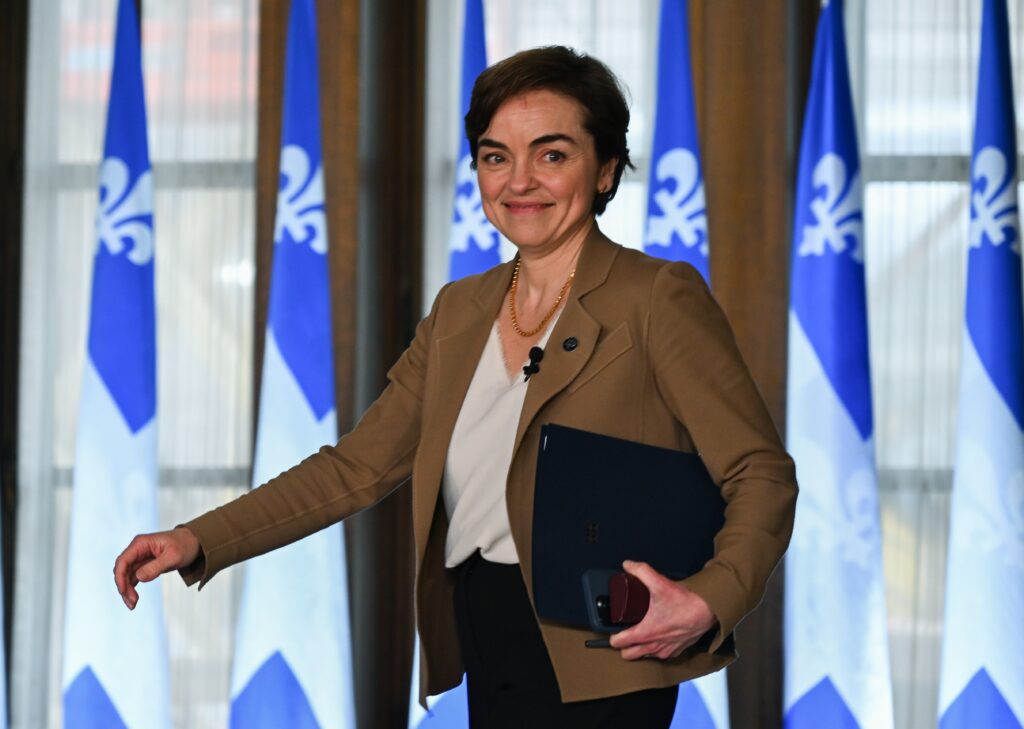

Quebec Premier Christine Fréchette says the province needs to become more economically independent as the world grows increasingly uncertain.
Speaking Tuesday at an event by the Montreal Council on foreign relations ahead of the next provincial election, Fréchette outlined her government’s new international policy, saying Quebec needs to expand its trading relationships, strengthen its presence abroad and defend its own interests on the world stage.
She says that’s especially important as the trade war with the United States continues to put pressure on Quebec businesses, workers and regions.
“In a world where everything is becoming fleeting, I believe that what we have achieved has never been more valuable. Above all, we must promote and defend our interests and priorities regarding all issues that concern us,” said Fréchette.
“We are ready to face that threat, and I asked the federal gov to be ready to help businesses and to help workers as well,” she added.
“I’m anxious. I’m preoccupied because there’s a lot at stake. We are talking about imposing 50 per cent tariffs on products coming from Quebec, which were protected by the USMCA until today.”
Fréchette says Quebec remains too dependent on the U.S., with roughly two-thirds of its exports still going to its southern neighbour.
Fréchette said she felt “we’re still a long way off” from a world without tariffs, when asked if she thought she would ever see such a possibility.
“The American administration has changed its tune on this issue. (…) I do not see with the United States, a day soon, in the short term, when we could find a framework without tariffs. The discourse is that we will have to live with this. How high now? That’s what remains to be negotiated,” said the leader of the Coalition Avenir Québec.
Fréchette made the comments less than 12 hours before she was set to find out if U.S. President Donald Trump would follow through on his threat to impose tariffs on $28 billion worth of Canadian goods just after midnight.
Her plan calls for diversifying those markets, particularly in Europe.
The premier says the goal is to make Quebec more resilient and more autonomous.
The premier said she was concerned about the entry into force of this tariff salvo, which could, according to her, hit Quebec harder than the rest of Canada.
It said it had a plan if the tariffs were to come into force.
“We are ready in case there are rates imposed on us. These would be the largest to date. We have support plans for businesses. The federal government also has them,” said Fréchette.
It should be noted that Quebec is already affected by sectoral customs duties from Washington on aluminum and steel as well as on the softwood lumber industry.
In her speech to the MCFR, Fréchette recalled that she had recently presented a new international policy for Quebec.
This policy “deepens” the Gérin-Lajoie doctrine, which postulates that Quebec’s international field of action must be the extension of its internal constitutional jurisdictions, she said.
“From now on, under a Fréchette government, Quebec will be able to assert itself anywhere in the world on any issue that affects the interest of our nation.
“I am thinking in particular of issues that affect the prosperity of Quebecers, the protection of our state, our territory, or the defence of our language, our culture. To achieve this, we will conduct diplomacy that is both economic and influential,” explained Fréchette.

Trade with the United States would remain “central” for a future CAQ government on the international level, while working on market diversification, she said.
The premier was the last leader among the five main political parties in the National Assembly to respond to the MCFR’s invitation, as part of the series “Québec 2026: The world at the ballot box” in the run-up to the October 5 general election.
-With files from the Canadian Press
Jacques Boissinot
Add CityNews Montreal as a trusted source on Google to see more local stories from us.
