

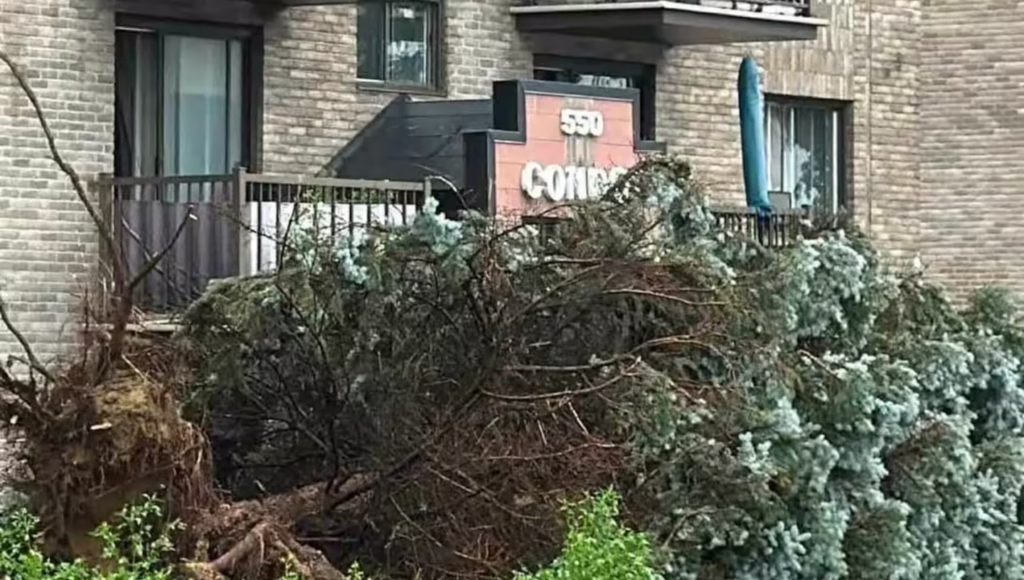

The concrete blocks outside Place Laurier plaza in Repentigny were heavy enough that most people would never expect them to move.
But after a tornado swept through the area on Aug. 2, local resident Daniel Desrosiers said they had been tossed over by the wind.
“The concrete blocks, as you saw in the videos, had been blown away by the wind and were completely overturned,” he said. “The owner of the plaza took care of the repairs that very same day to at least protect what was left.”
While much of the cleanup was already complete when CityNews visited Friday, residents are still taking stock of the damage left behind after the EF-0 tornado packed winds of up to 130 km/h, uprooting trees, ripping shingles off roofs and sending backyard objects flying. Nobody was injured.
The tornado was Quebec’s sixth in just two months and the province’s third in less than two weeks.
An increasing amount of severe weather is “a fact” within the region, resident Ruben Axel told CityNews.
“The more the years go by the more intense summer storms get,” he said, “and the more mess it makes.”
Axel said his home escaped major damage, though some neighbours were less fortunate.
“I’d say I just barely got by,” he said. “Others had their roofs torn off by the strong winds.”
But despite the damage in Repentigny, experts say the tornado itself was relatively weak. The early August twister has been classified as an EF-0, at the upper end of the weakest category on the Enhanced Fujita (EF) scale, whose strongest tornadoes can whip up winds exceeding 320 km/h.
“That tornado was actually pretty brief,” said David Sills, director of the Northern Tornadoes Project (NTP). “The track was only 1 km long and about 100 metres wide, so pretty small.”
Quebec’s tornado season typically runs from May to October, Stills said. Additionally, six tornadoes within the span of two months isn’t “anything unusual,” despite seeming like an especially dense cluster of activity.
The province usually receives up to 11 tornadoes annually, meaning that 2026 has been a relatively quiet year.
“(Weather patterns) this year have just not been conducive to tornadic storms as much in the eastern part of the country,” Still said.
Generally, the amount of tornadoes that wind up in a given area is dependent on the region. However, Stills added that climate change is causing weather patterns to be stuck in different parts of Canada, causing repeated meteorological events for extended periods of time.
“We’re seeing more and more that we get locked into patterns long term,” Sills said. “What that does is it results in droughts in certain places, and that leads to fires. It results in a lot of rain in other places.”
The Prairies have also generally seen fewer tornadoes over the past 40 years while Ontario and Quebec have experienced more.

“There’s a lot of variation from year to year,” Sills said. “Some years will be higher and some years will be lower. But on average, we’re seeing this eastward shift.”
Researchers caution that it will take years to determine whether tornadoes are becoming more common in Quebec. In the meantime, they say each tornado provides valuable data that helps scientists better understand how severe weather is changing across the province.
Add CityNews Montreal as a trusted source on Google to see more local stories from us.
