

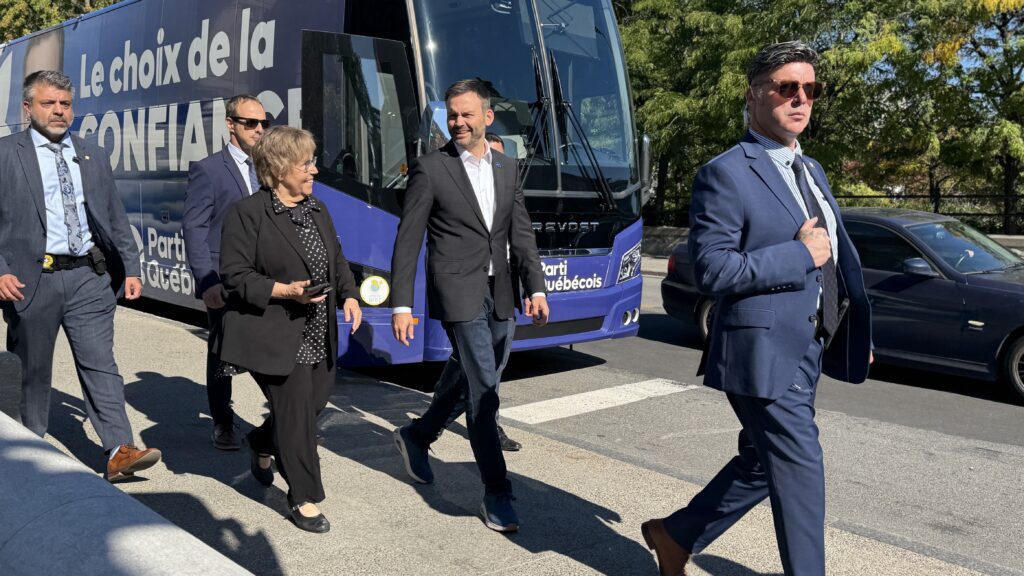

Quebec’s five main party leaders clashed over independence, health care and immigration Wednesday night in their final French-language debate, with the question of Quebec’s future in Canada taking centre stage 12 days before the Oct. 5 election.
The leaders were asked to look 30 years ahead and consider whether Quebec would remain part of Canada or become a country of its own.
Parti Québécois Leader Paul St-Pierre Plamondon argued independence is the logical path for Quebec, given its place in North America.
“Given that we are only two per cent of the French-speaking population in North America, the logical thing is to become a country and that moment is coming,” St-Pierre Plamondon said during Wednesday’s debate.
Quebec Liberal Leader Charles Milliard criticized what he called the PQ leader’s insistence on holding another referendum. “That stubbornness harms Quebec, and it persists in the idea of holding a referendum when 70 per cent of Quebecers do not want one,” Milliard said during a press conference in Sherbrooke Thursday.
Conservative Leader Éric Duhaime also argued the issue should not be a priority.
“I don’t think this is the right time at all to delve into a referendum. Seventy per cent of Quebecers don’t want one,” he said during Wednesday’s debate.
Québec solidaire co-spokesperson Ruba Ghazal defended the idea of independence as a democratic choice during the debate.
“For me, yes, Quebec independence is fundamentally a democratic project,” she said.
CAQ Leader Christine Fréchette argued Quebec can continue advancing within Canada.
“We are the ones who will demonstrate that we are capable of moving forward. In this context, it is a Canadian framework with a Carney government,” she said speaking to media on Thursday.
The leaders also sparred over health care and immigration, with the CAQ’s record in health care coming under criticism from the other parties.
Political analyst Daniel Tran said the debate marked a change in how the referendum question was handled.
“This is the first debate where referendum wasn’t used as a boogeyman, or that we put it under the rug,” Tran said.
Montrealers offered mixed reactions to the renewed debate over sovereignty.
“I understand wanting their own identity and potentially like separating, but I think it’s just more a bit of an anxiety inducing kind of idea to me,” said Rosie Puok.
Vincent Castro questioned whether separation would improve life for Quebecers. “We’re already living in freedom, right? I don’t think being separate from Canada will make something better for the Quebecois,” he said.
But Ben Clarkson, who has lived in Montreal for 10 years, said Quebec’s distinct identity sets it apart from the rest of Canada.
“Quebec is a different country. It’s a different country than the rest of Canada. It has a different culture. It has a different language,” he said.
With the final debate behind them, the campaign has entered its last stretch. Duhaime said Thursday the parties were beginning the “final sprint.”
The remaining question is whether the debate changed any minds.
Puok said she has not decided how she will vote and plans to do more research. “I haven’t made a decision yet, but I do think watching the debate will help,” she said.

Clarkson said he has already made his choice but did not watch the debates, saying the larger issues facing Quebec matter more to him.
Tran said all five leaders made the most of their final opportunity to face off.
“All candidates really seized the moment with this championship round. Definitely you can tell that there was fire in their eyes, especially with the last debate,” he said.
Quebec voters go to the polls Oct. 5.

Add CityNews Montreal as a trusted source on Google to see more local stories from us.
