

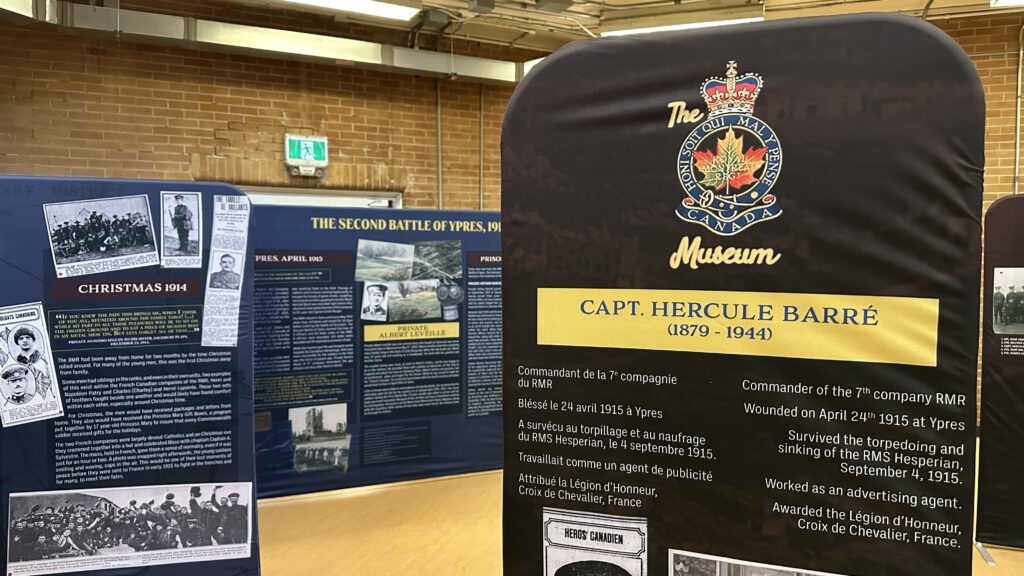

A new temporary exhibit has opened at the The Royal Montreal Regiment (RMR) Museum, in the lead up to Remembrance Day.
The exhibit focuses on the francophone companies of the RMR and their heroic contribution to the second Battle of Ypres, which was fought from April 22 to May 25, 1915, in Flanders, Belgium.
“Ypres had been kind of centered to a battle earlier, but the Canadians weren’t there. The second battle of Ypres is when the Canadians kind of came in. It’s also the first major battle where the Germans successfully used poison gas. So it was very effective, unfortunately, to the Canadians,” said Amynte Eygn, the assistant curator of the RMR Museum.
The battle was a strategic victory for the Allies during WWI and marked the first major engagement of Canadian troops in the war.
“This Remembrance Day, we look back 111 years to an infamous battle and the role played by soldiers from our Regiment,” says Colin Robinson, Former Commanding Officer, RMR. “The idea of bilingualism in the Canadian Armed Forces seems self-evident today but in WWI it was very progressive. In fact, the RMR is the first bilingual unit in Canadian military history.
“In this exhibit, we focus on G and H companies, which were identified as French-Canadian at the time. We also touch upon subjects including trench warfare, PTSD, desertion, managing disabilities and post-war reintegration into Canadian society. Through personal stories, letters and photos, the exhibit aims to humanize the young men who fought bravely for Canada. We honour their legacy and reflect on how ordinary Canadians achieved the extraordinary. We invite citizens, educators and students to visit us. Lest we forget.”
“The second battle of Ypres was dramatic and traumatic, not just for the soldiers, but also for their families,” said Robinson. “There was no protection, there was no equipment, there was no training. They thought it was a rumor when they’d heard of it because they’d taken some German prisoners who’d given them an idea that this gas attack was coming. What the heck is gas? What are you talking about?”
In the first 48 hours, Canadians suffered more than 2,000 fatalities. Additionally, the loss of life inspired Canadian Lieutenant-Colonel John McCrae to write “In Flanders Fields”.
“It’s extremely personal and I think it’s really important to remember them 120 odd years on because they really sacrificed a lot for us and I hope that their memory lives on in this, honestly, because they deserve it,” said Eygn.
The exhibit is free for the public from 10 a.m. to 6 p.m., from Nov. 4 to 15.


Add CityNews Montreal as a trusted source on Google to see more local stories from us.
