


Squeamish Salish swimmers take note.
The discovery of two new species off of the coast of British Columbia may not be what you want to hear today.
“If you’re swimming in the Salish Sea late at night and feel a skittering along your calves, tiny hairy feet tip-tapping their way higher and higher towards your face, don’t worry, it’s probably just the stuff of nightmares: hairy-legged, red-eyed sea spiders newly discovered by UBC researchers,” the university said in a news release.
Two new species of sea spiders are the first to be documented in the Salish Sea in almost a century, according to lead researcher and zoologist Cormac Toler-Scott.
The tiny marine arthropods — don’t let the “spider” in the name fool you, as they are not actually arachnids — were collected between September 2023 and August 2024 in areas around Vancouver, Quadra Island, Bamfield, Victoria, and others.
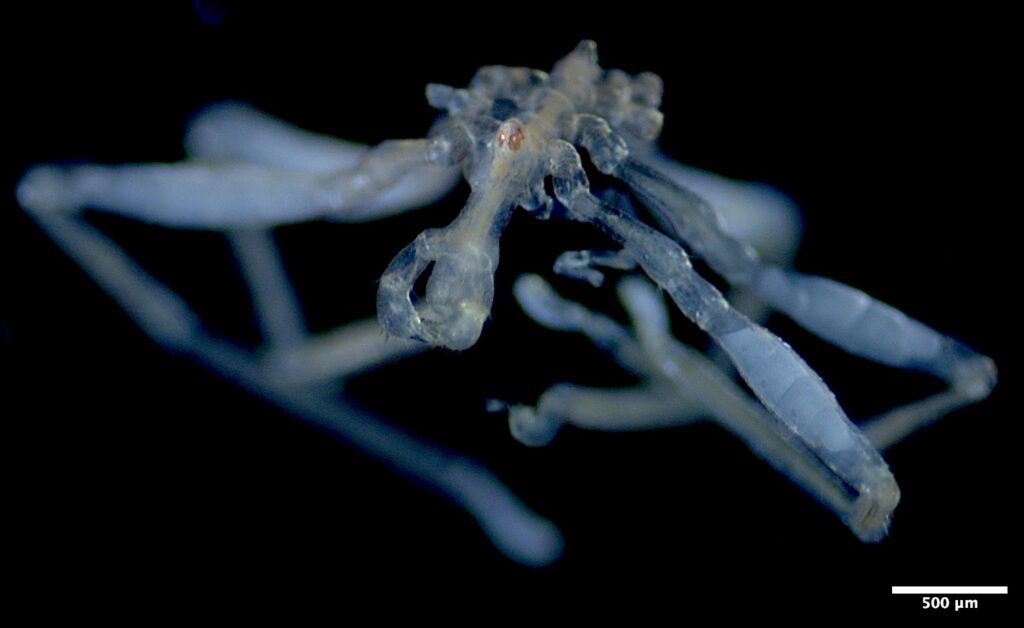
One of the species is called Callipallene pilosuspedes. “Pilosuspedes” is a play on Latin meaning “hairy feet,” and this critter is so named because it has long, curved spines covering its lower legs, UBC says.

“It sports red eyes, a short proboscis with claws to grasp food before biting, and a triangular, three-lipped mouth covered in sensory tendrils – a tiny marine Sarlacc pit, if you will,” the school said.
It also has specialized appendages the creature uses to groom itself.

The second species is called Tanystylum kiixin, pronounced “kee-hin,” and is named after an ancient Indigenous village near where it was discovered, researchers say. Unlike the pilosuspedes, this creature has small limbs and can’t groom itself well, which researchers say made it often appear to be covered in debris and tiny parasites. Toler-Scott says this effectively creates “an ecosystem within an ecosystem within an ecosystem.”

UBC says sea spiders evolved around 500 million years ago and are related to scorpions, spiders and horseshoe crabs. Researchers say they can have up to 12 legs, and they also have a sucking proboscis and can range in size from less than a centimetre all the way to more than 70 centimetres.
“They’ve retained some weird traits,” said Toler-Scott. “A lot of the shallow water species are quite small, and so they’ll live as parasites on larger organisms, and they use this weird apparatus called a proboscis to suck the juices out of their host.”
Researchers say the two new species have been registered in a global database. Toler-Scott says there are more waiting to be found.

“I only had one field season but there’s definitely more diversity out there that we haven’t documented.”
Add CityNews Montreal as a trusted source on Google to see more local stories from us.
